Does Alcohol Really Make You More Confident? | Borrowed Confidence Loop
Oct 08, 2026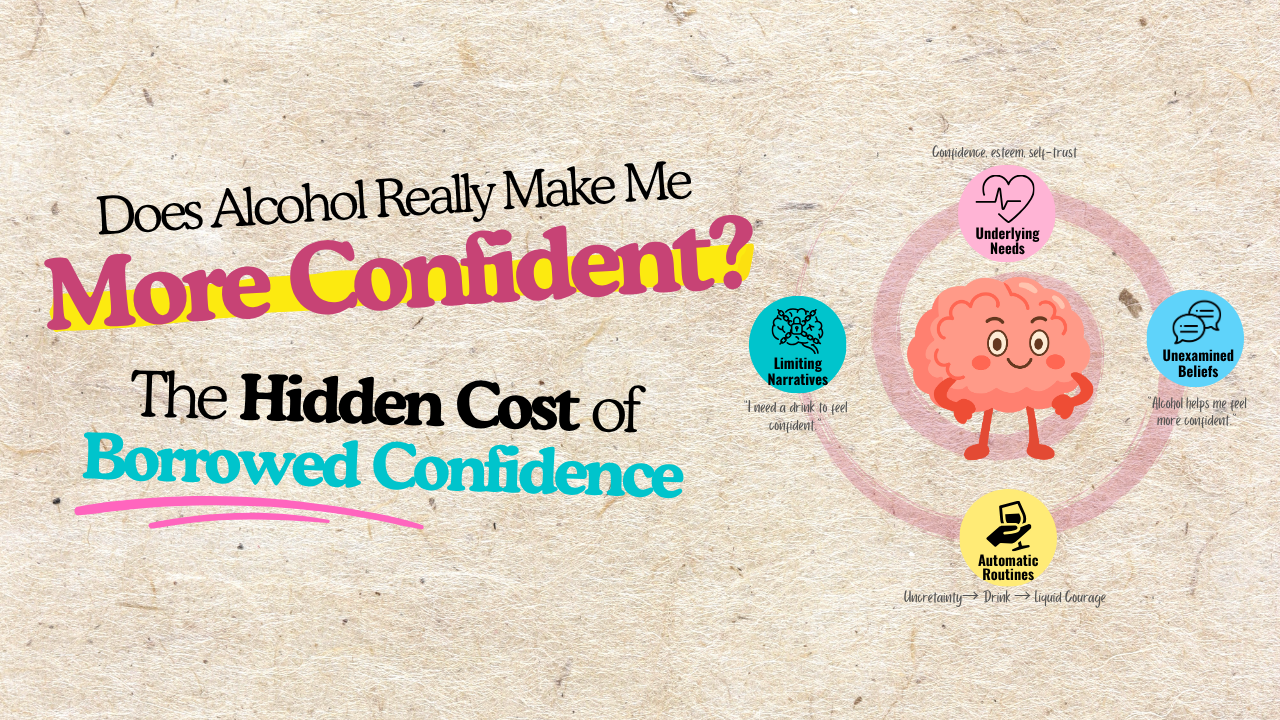
One of the things that people often feel reluctant to let go of when they quit drinking is the quick confidence boost that alcohol seems to offer.
Why does alcohol make me feel more confident?
Alcohol can temporarily lower our inhibitions and make fear, anxiety, and self-doubt feel quieter in our head.
While this can feel like increased confidence in the moment, it doesn't necessarily mean we've developed more trust in ourselves.l I call this distinction borrowed confidence vs. earned confidence.
Confidence is an important thing to have in life. It allows us to go for the things we want in life. Plus, confidence feels good. Who among us doesn't like to feel that sturdy sense of certainty and self-assurance?
But the tricky thing is, confidence is not the natural feeling for most of us when we face something new or uncertain. Instead, most of us experience self-doubt; we worry we’ll fall short; and no matter how hard we try, there seems to be little we can do to get rid of the butterflies in our stomachs.
Don’t we wish that there were a potion that we could just take a big sip of, and it would magically give us the confidence boost we need? That’s why it can almost feel like a Christmas wish came true when we discover alcohol and the quick confidence boost it seems to offer. And even when we decide to let go of alcohol, we miss the confidence boost we get from it.
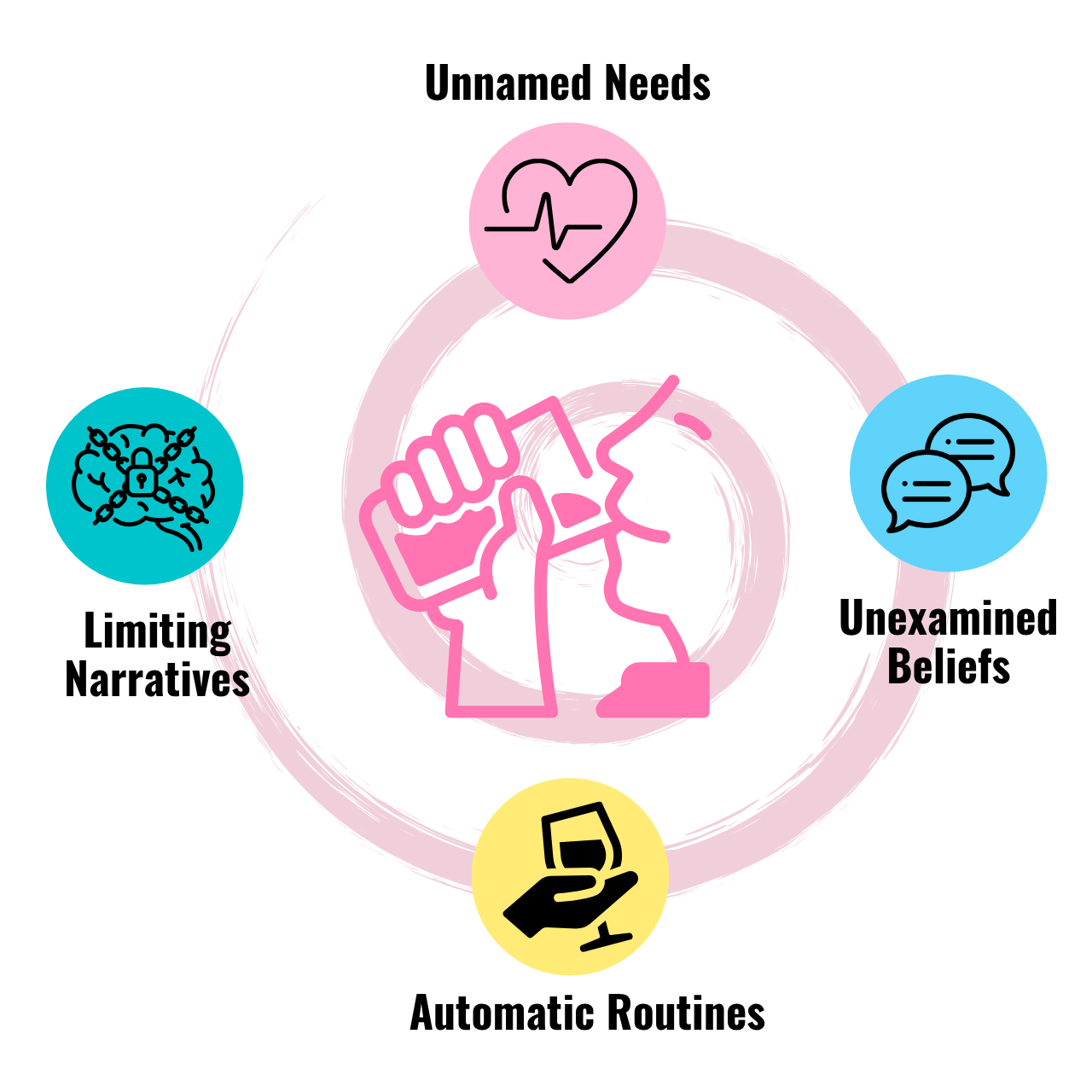
The Belief: “Alcohol Makes Me Feel More Confident”
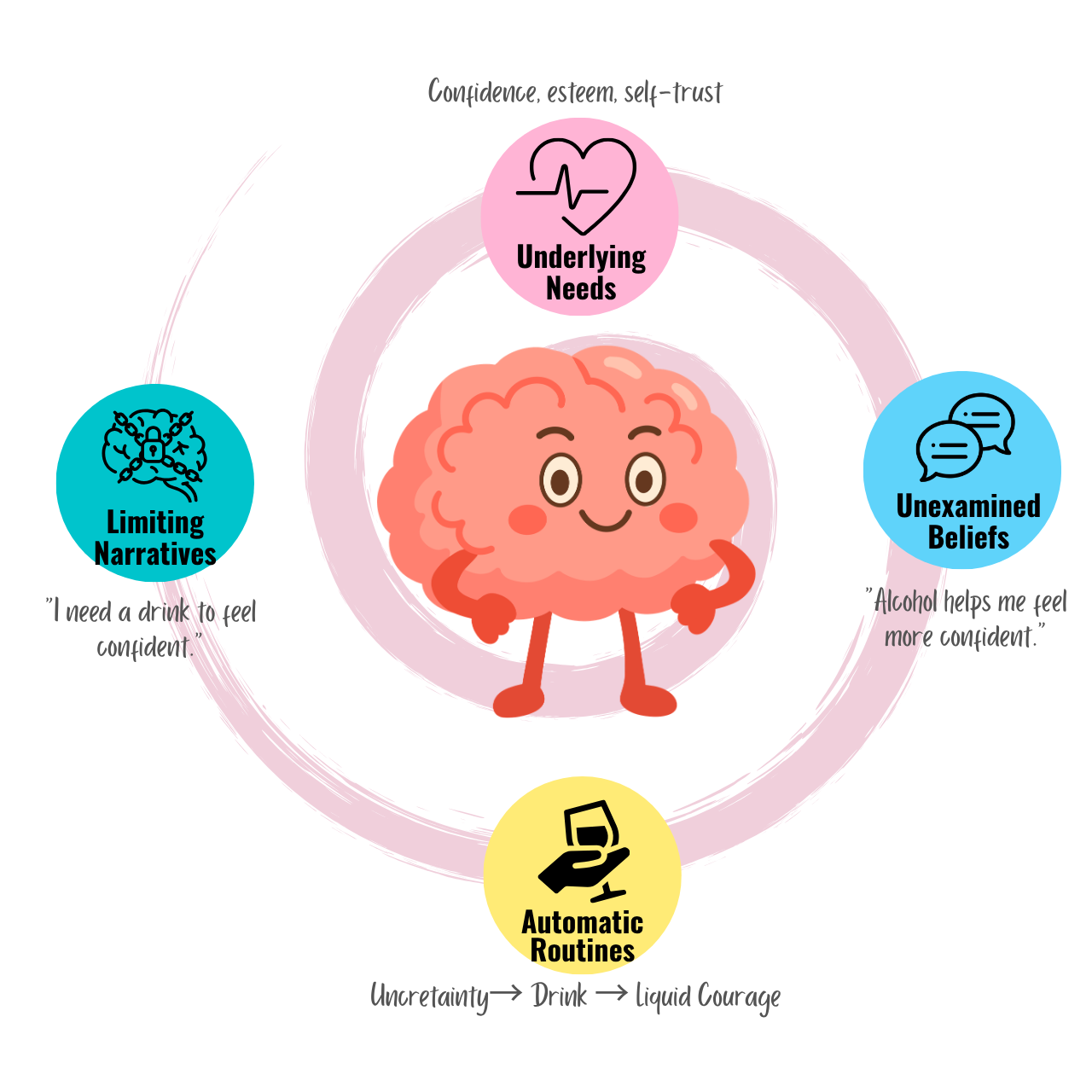
Behind the things we miss about alcohol, there is often a spoken or unspoken belief we hold about what alcohol can do for us. In what I call the Invisible Drinking Loop, these unexamined beliefs are one of the hidden forces that often keep pulling a person back to an unhealthy drinking pattern.
These beliefs are often formed through observation and personal experience. For example, perhaps you’ve learned to associate alcohol with liquid courage after watching your favourite character on TV take a big swig of whiskey before walking up to an attractive stranger. Or you stumbled upon the welcome effect yourself. As fear and self-doubt faded into the background after two cocktails, a belief that “alcohol helps me feel more confident” started to take hold.
When an unexamined belief is left unnamed and unexamined, it often continues to fuel the desire to drink and create a sense of missing out even when we have stopped drinking. That’s why, to truly outgrow an old relationship with alcohol, it’s important to take a closer look at beliefs we may continue to hold about alcohol.
In this case, beneath the lingering desire, it’s a belief that sounds something like “alcohol helps me feel more confident.”
How Does Alcohol Create the Feeling of “Liquid Courage”?
To examine this belief, it may help to first look more closely at what confidence really is.
According to the Oxford Dictionary, confidence is defined as the belief that one can rely on someone or something. So, self-confidence is about our ability to trust and rely on our abilities or skills. As our trust in ourselves grows, our confidence often increases.
Alcohol, unfortunately, doesn’t come with the magic power to give us more self-trust than we already possess. Rather, it creates a feeling of confidence through a different mechanism: muting our fear. As a central nervous system depressant, alcohol can temporarily dampen anxiety, slow our thinking, and lower our inhibitions, making fear and self-doubt feel quieter.
In other words, the confidence boost we experience from alcohol has less to do with increased self-trust and more to do with decreased fear and self-doubt.
The Hidden Price of Liquid Courage
If you are anything like me, you may be wondering: does it really matter if the confidence I feel comes from more self-trust or less fear, as long as it allows me to do the things I want to do? You would be right to wonder, because in the short run, it often doesn’t matter. It’s only in the long run that borrowing confidence can come with hidden interest.
Now let's imagine two different hypothetical scenarios. Say it was your best friend’s engagement party and you were asked to give a speech. You love your friend dearly, and you couldn’t be more excited for the couple, yet you are terrified of speaking in front of a crowd.
In Scenario A: When the time came, your hands were shaking, your heart pounded, and you stumbled over the first sentence. But you pushed through it, and after the first two minutes, your breath slowed down, and you felt a bit calmer. You finished the speech, and everyone clapped.
Now let's look at Scenario B: It was time for the speech. To calm your nerves, you took a big swig of whiskey. As you walked onto the stage, you could feel the effect of alcohol. You felt less nervous, and you even told a joke that made everyone laugh. The speech went great, and people clapped.
In terms of the immediate outcome, you actually got the same result, perhaps even a slightly better one in Scenario B. And that is the tricky part, because the hidden interest doesn’t lie in the immediate result; it lies in what the experience teaches our brain.
In Scenario A, your brain gets the message: "I can be afraid and still handle this."
In Scenario B, your brain gets the message: “I don't know if I can do this without drinking.”
That’s why I like to call the confidence we gain through facing what we’re afraid of earned confidence, and the one we get from muting our fear borrowed confidence. In the former, you learn to trust yourself slightly more. In the latter, you learn to rely on alcohol slightly more.
And that is where the loop begins. I call this the Borrowed Confidence Drinking Loop. A Borrowed Confidence Drinking Loop is an unhealthy drinking pattern driven by our underlying need for confidence and self-trust and fueled by the belief that alcohol gives us confidence. Over time, drinking becomes our default response whenever we need a confidence boost. What begins as an attempt to increase our confidence can gradually move us further away from, rather than closer to, the confidence and self-trust we deeply desire.
HHow to Build Confidence Without Alcohol
To get out of the Borrowed Confidence Drinking Loop, we need to first recognize the difference between earned and borrowed confidence. Here is how I differentiate them myself:
- Earned confidence is the prize I get when I step outside my comfort zone and discover, “I can handle this even while I’m afraid.”
- Borrowed confidence is the low-hanging fruit that lets me stay inside my comfort zone by muting my fear, leaving me to believe, “I can only handle this because something took the fear away.”
To break a Borrowed Confidence Drinking Loop is often not enough to simply remove alcohol. We need new tools and skills that would allow us to earn confidence so that we can stop borrowing. If you’d like a place to start, you can start with these 4 practice steps to stop borrowing confidence from alcohol.
4 practical steps to stop borrowing confidence from alcohol.
Join the Beyond Alcohol Project
Created for sober-curious people, once a week, I share bite-sized writings to help growth orientated individuals to make sense of their relationship with alcohol through a more compassionate lens and explore how to create change through empowerment and intention.
Frequently Asked Questions
Does alcohol actually make you more confident?
What is “liquid courage”?
How does liquid courage undermine real confidence over time?
What is a Borrowed Confidence Trap?
How can I become more confident without alcohol?

Take the first step toward change
Twice a week, I send short, bite-sized micro-dose emails to help you interrupt the invisible loop that keeps pulling you back—so you can replace it with something new.
By signing up, you'll be added to Jeanette's newsletter list. You can unsubscribe at any time